The most ambitious goal of the MNMA was to conduct evaluative research in an effort to determine which notation systems were most promising as potential replacements for traditional notation.
In pursuit of this goal the MNMA carried out a research project that spanned several years and was concluded in 1999. It was organized into the following four steps.
- Step 1 : Collection
- Step 2 : Eleven Preliminary Screens
- Step 3 : Six More Subjective and Detailed Screens
- Step 4 : Evaluation by Musicians
- Results in Brief
- Excerpt from the Report on the Results
- Notation Systems Sorted by Average Score
Step 1: Collection
Over 500 music notation systems, new and old, established or proposed, were collected from all over the world. They were then researched and documented in the book Directory of Music Notation Proposals, by Thomas Reed.
Step 2: Eleven Preliminary Screens
A set of 11 criteria, or “screens” were adopted to establish the minimum standards that the music notations should meet in order to merit further consideration. Applying these screens winnowed the pool of hundreds of music notations down to a manageable 45.
- The notation is convenient for a human writer (as contrasted with a machine) to express musical ideas. The notation is convenient for a human performer to recreate those musical ideas.
- The notation can be written conveniently and quickly with nothing more than a writing tool (such as a pencil) without the absolute necessity of a ruler or other drawing aids or specially prepared paper. In other words, a plain piece of paper and a pencil, or a chalkboard and chalk should be sufficient for quickly notating music in the notation if desired.
- The notation is independent of all musical instruments for intelligibility so that the notation is readily adaptable to all instruments including the human voice.
- The notation can express music of all reasonable degrees of complexity – not only simple music.
- The notation is relatively simple so as to be practical for both children and adults.
- The music is flexible enough so as to be appropriate for the music of the past, present, and foreseeable future, as well as to music of various cultures, and to both solo and ensemble performance.
- The notation is writable using only a single color on a contrasting background (for example black on white) without shading or tinting. Such a monochrome system offers the maximum in simplicity and convenience, and is considered essential, especially since many people have some degree of color-blindness.
- The notation possesses a fully proportional pitch coordinate, where each of the twelve common pitches is spaced in a graphic manner, so that progressively larger pitch intervals have progressively larger spacing on the coordinate, providing a visual representation of each interval that is exactly proportional to its actual sound.
- The staff, or graph, shows an octave cycling effect, or octave periodicity, so that each successive octave appears the same or substantially the same, making it possible to recognize notes in any register after learning one octave.
- No more than five identical, successive, and equidistant staff lines are shown, so that staff lines can be quickly identified without counting lines.
- Both the lines and spaces of a staff are used as positions for notes on the pitch coordinate in order to economize on paper space and therefore on eye movement.
Step 3: Six More Subjective and Detailed Screens
A second set of 6 more subjective and detailed screens were applied to the remaining 45 music notations, winnowing them down to the 37 that would be evaluated by musicians in step four.
- (12.) Adequate provision for voice leading (keeping multiple melodic lines distinct) is provided.
- (13.) The time coordinate must provide for proportional (or approximately proportional) graphic spacing of notes, rests, and other events, and must also provide for mathematically understood symbols for the divisions and multiples of time values, except optionally in children’s music and situations where graphic representation of time values alone may be adequate.
- (14.) The notation is adaptable to a variety of microtonal systems.
- (15.) The notation system must allow the pitch axis to be uninterrupted (made continuous) so that the staff can encompass an arbitrary number of octaves while preserving proportionality of pitch. In addition, the notation system must allow the pitch axis to be interrupted (made discontinuous) at convenient points in order to provide separate staves for specific instruments or voices in an ensemble, or to separate the two hands in keyboard music, when desired. Both options (continuous and discontinuous) must be available.
- (16.) The notation provides for the convenient addition of optional or supplementary kinds of information, which may or may not be necessary or desired in some music (for example, information about dynamics, expression, tonality, choice of instruments, tone color, lyrics, etc).
- (17.) Frequently used symbols must be at least as convenient to write in longhand as are the corresponding symbols of traditional notation. For example, if the noteheads are all rectangular, or require unusually precise drawing, they take an unacceptably long time to draw. Exceptions are allowed for symbols that provide some benefit missing from the traditional system, as long as the overall amount of time to write a typical piece of music is not noticeably longer than in traditional notation.
Step 4: Evaluation by Musicians
The final evaluation was completed by a group of seven trained musicians. They assessed the remaining 37 notation systems by conducting the following series of hands-on exercises. This step is further documented in the book Test for New Notation Systems by Thomas Reed.
- (18.-22.) Reading a chromatic scale for each system and grading each system according to 5 criteria (ease of identifying staff lines and spaces, ease of writing a note a Major 3rd above the top line of the staff and below the bottom line, ease of reading a piano staff version, ease of recognizing noteheads, ease of reading successive octaves)
- (23.-27) Writing out a G-minor scale for selected systems and grading each according to 5 criteria (ease of writing noteheads, ease of writing 3-octave range, ease of recognizing it as a melodic minor scale – as opposed to harmonic minor, pure minor, or major scale, ease of writing the time system, ease of selecting the best type of manuscript paper)
- (28.-32.) Writing out last 4 measures of a fugue (Bach’s Toccata and Fugue in D minor for organ, BWV 565) and grading selected systems according to 5 criteria (ease of selecting manuscript paper, ease of using voice leading indications – showing which notes belong to which voice even when crossing, ease of using “tie” symbols, ease of use by an organist, ease of designating use of left or right hand)
- (33.-38.) Writing out first 4 measures of Ravel’s D’anne qui me jecta de la neige (from Deux Epigrammes de Clement Marot for voice and piano) and grading selected systems according to 6 criteria (adequate expression of pitch information, adequate expression of time and note duration, ease for soloist and pianist, adequate expression of ornaments, ease of writing, adequate readability)
- (39.-44.) Writing out a specific measure from an orchestral work (measure 2 of rehearsal #161 from theSacrificial Dance of Igor Stravinsky’s Rite of Spring, Dover edition), and grading selected systems according to 6 criteria (adequate accommodation for 30 staves, ease of fitting the parts on the staves without using numerous ledger lines, degree of freedom from octave register changes or clef changes, legibility if photographically reduced, legibility of symbols, legibility of expression marks in blank paper space)
Results in Brief
This research project spanned many years. In summary, more than five hundred notations were collected and presented in the Directory of Music Notation Proposals. Forty-five of these notations passed successfully through step two. Thirty-seven passed successfully through step three (see list of systems below). The responses from the seven musicians participating in step four were analyzed and presented in the “Report on the Results of the MNMA Evaluation Test.” An excerpt from this report is included below. The complete responses from each musician who participated in step four were subsequently published in full detail in various issues of Music Notation News, including illustrations of their transcriptions.
Although the results were not as conclusive as had been hoped, much was learned from the study. There were two notation systems that were the most highly rated:
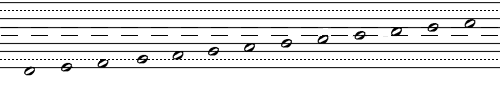
- Thomas Reed’s Twinline, a variant of Leo de Vries’s Chromatic Twinline notation.
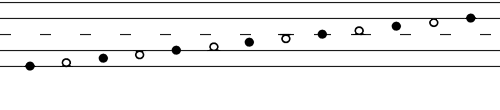
- Richard Parncutt’s 6-6 Tetragram, considered jointly with Albert Brennink’s A-B Chromatic Notation, of which it is a minor variant.
Excerpt from the Report on the Results
(The following is a short excerpt from the full “Report on the Results of the MNMA Evaluation Test” written by Doug Keislar. The full text includes statistical analyses of the participating musicians’ responses and was published in the Vol. 10, No. 2, 2nd Quarter 2000 issue of the MNMA’s Music Notation News.)
If the evaluators had been close to unanimous in their opinions of the best systems, interpreting the results would be straightforward. As it turned out, they were far from unanimous, meaning that one must examine the results carefully before drawing conclusions. If one must choose an existing system based on the test results, with none of the improvements suggested by the evaluators (and not allowing for future proposals), I see two candidates, depending on the criteria one uses.
Only one system was chosen as a final preferred system by two evaluators: LP #15, Parncutt 6-6 Tetragram. The fact that this system is a minor variant of LP#14, Brennink, which was chosen as a third evaluator’s final system, strengthens its position considerably. Taken together, Brennink’s system and Parncutt’s variation of it won three of the seven final “votes” by evaluators, which is a strong plurality. Unfortunately, these three evaluators were not wildly enthusiastic about the system. One rated it somewhat worse than traditional, another about the same, and the third somewhat better. This is not the kind of ringing endorsement that would convince the world at large to bother learning the system as an alternative to traditional notation, much less as a replacement for it.
Only one system among the final choices received an evaluation of “much better than traditional”: LP#6, Tom Reed’s Twinline. This is the kind of ringing endorsement one would hope for, but unfortunately it came from only one out of seven evaluators, far from a consensus. However, if one examines the overall numerical results instead of only looking at the final choices, the position of LP#6 does become somewhat stronger: it receives the highest numerical rating in all the analyses of the scores, higher than LP#15 (or LP#14). The final report will include all evaluators’ numerical responses to all questions in the test, so that readers can verify my analyses if desired.
These two systems, LP#14/15 and LP#6, represent the work of two men who have each devoted innumerable hours to the problem of notation reform: Albert Brennink and Thomas Reed. (Parncutt’s contribution to Brennink’s system, while evidently deemed a worthy improvement by the evaluators, cannot be considered the product of decades of research in notation reform; so it seems fair to lump his system together with Brennink’s in the present discussion.) Certainly one cannot assert that either Brennink’s or Reed’s system is carelessly designed. Brennink’s system is closer in appearance to traditional notation; at a glance, it can actually be mistaken for traditional notation. Reed’s system, on the other hand, ostensibly avoids the problem that plagues almost all chromatic notation proposals: their less efficient use of space on the page.
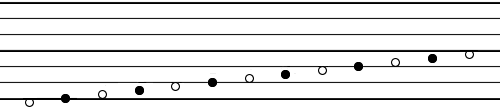
In short, I find that both the Brennink/Parncutt system and the Reed Twinline system have their advantages. The former system’s greater similarity in appearance to traditional notation would probably make it easier to promote. However, I also see advantages to some features of systems that no evaluators selected as a final choice. (For example, the use of alternating black and white noteheads would accentuate the staff lines and spaces, allowing music to be printed smaller, and it would also highlight intervallic patterns, facilitating transposition and improvisation.) Perhaps a composite system can be imagined. I think it likely that a notation system superior to any of the 37 studied in this test can, and eventually will, be invented. I will not predict whether the world at large will adopt such a system (or any of the existing ones); it might well be that traditional notation is too entrenched to be replaced, or even significantly displaced, in the foreseeable future (say, within the next century). Perhaps only a system that is an order of magnitude better than the ensconced system, not merely twice as good, can effect such a global change. One can, however, foresee that computers will make it much easier for experimentally minded people to adopt notation systems of their liking and to translate music between those systems and traditional notation.
Notation Systems Sorted by Average Score
Below are the thirty-seven notation systems that passed the seventeen screens of steps two and three and were then evaluated by seven musicians in step four. They are sorted by their average score as awarded by the musician-evaluators, with the highest-rated systems shown first.
The MNMA does not claim that this ordering should be considered authoritative, but it does provide a cursory look at the thinking of the seven evaluators. Note that all seven musicians were well-versed in traditional notation, which would inevitably have an impact on their impressions, as compared with beginners. For a more detailed and thorough look at the results we encourage those interested to consult the full “Report on the Results of the MNMA Evaluation Test” in the second quarter 2000 issue of Music Notation News.
(A number of notation systems that are now presented on our website under Notation Systems were not included in this research because they were designed after it was completed in 1999 or were unknown to the MNMA at the time. (MUTO and Bilinear fall into the latter category.) See Music Notations Sorted by Date for more information.)
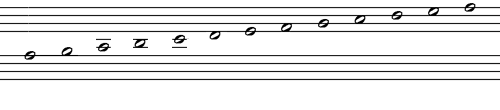
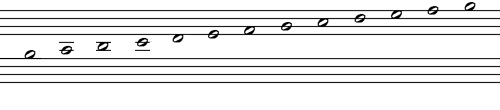
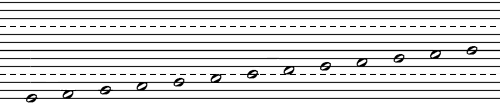
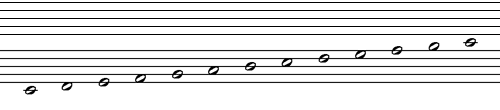
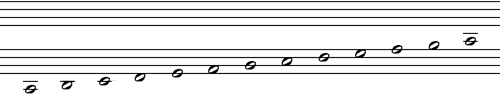
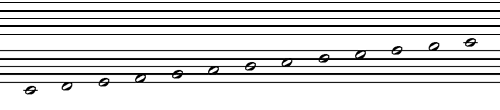
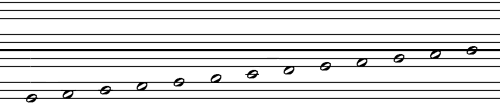
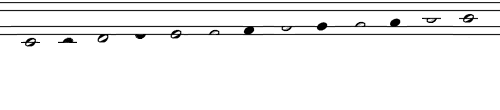
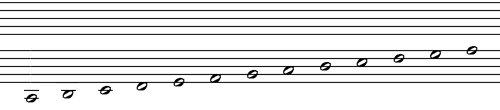
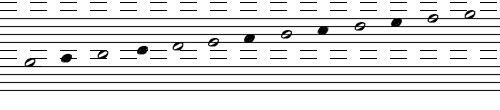
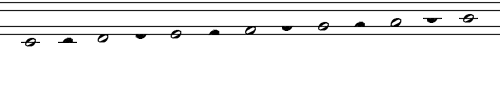
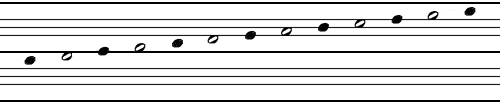
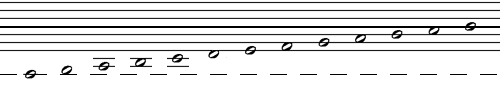
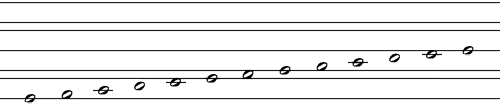
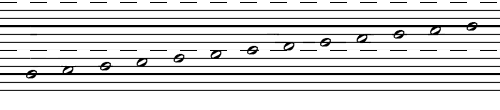
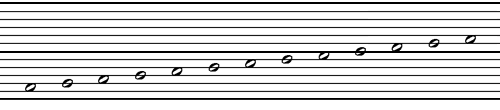
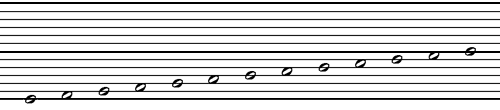
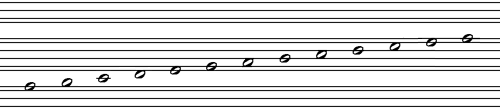
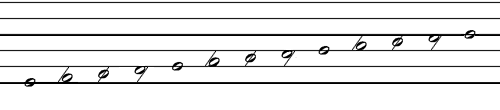
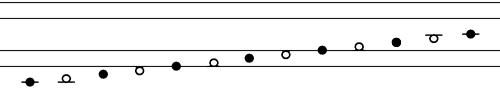
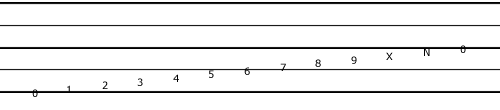
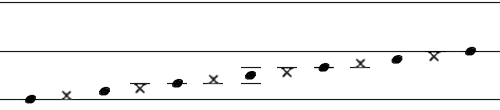
Each of the images below shows a chromatic scale from C to C. Click on the links to learn more about these notation systems.