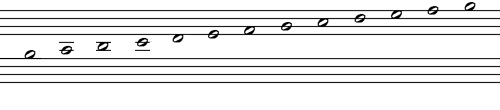
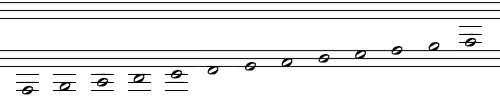
Lines a Whole Step Apart,  4 Lines per Octave

From the Guided Tour: Several systems have a four-line staff alternating with two adjacent ledger lines. They are similar to the five-line staves, but they are slightly less visually dense (or "busy"), and require more ledger lines. They are also less likely to be confused with traditional notation. Signs such as dynamic markings can be written in the space created by the ledger lines, even when multiple staves are stacked contiguously.
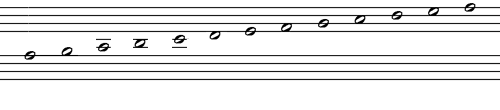
 

6-6 Tetragram by Richard Parncutt

In Parncutt's system the four lines are F, G, A, and B. The three spaces above and below the staff are C, D, and E. This aligns his staff with the familiar 7-5 pitch pattern so that the three spaces within the staff correspond to the group of three black keys on the piano (F#, G#, A#), and the two ledger lines correspond to the group of two black keys (C#, D#). Parncutt's design was his modification of Brennink's design (below).

Earliest documentation: 1996

Source: Directory of Music Notation Proposals, section/page: 10/21, 11/3, 13/62

Similar Notations: Keyboard (or 7-5) Trigram by Richard Parncutt, Untitled by Franz Grassl, 6-6 Trigram by Richard Parncutt

Miscellaneous examples: Major Scale Comparison  Triad Comparison  

Manuscript Paper: Discontinuous Staves  Continuous Staves

A-B Chromatic Notation by Albert Brennink

In Brennink's system the bottom line is F# so that the note A falls in the center of the staff. 

Website: Chroma Institute 

Earliest documentation: 1976

Source: Directory of Music Notation Proposals, section/page: 10/2, 11/3, 13/2

Similar Notations: Untitled by Franz Grassl

Manuscript Paper: Discontinuous Staves  Continuous Staves

Untitled by Johann Ailler

In Ailler's system the bottom line of the staff is E as with the traditional treble clef. This is the earliest of these three designs, although Brennink was not aware of its existence until after he had designed his version.

Earliest documentation: 1904

Source: Directory of Music Notation Proposals, section/page: 10/7, 11/3, 13/13

Similar Notations: Untitled by Franz Grassl

Manuscript Paper: Discontinuous Staves  Continuous Staves


Exploring alternative
music notation systems.