Lines a Major 3rd Apart,  3 Lines per Octave

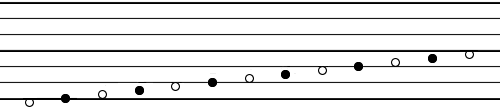
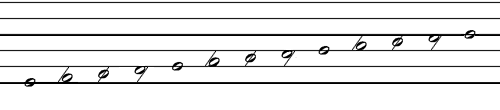
From the Guided Tour: These systems achieve a less dense appearance through lines that are spaced a major third apart. Between the lines are three elevations where notes are placed. One of the three lines per octave is either bold or dashed to allow for identification of the lines when more than one staff is stacked contiguously for a greater pitch range. Some systems use notehead color to help differentiate between adjacent pitches.
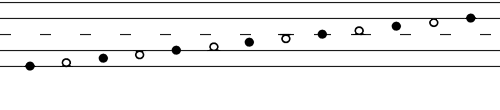
 

Chromatic 6-6 Notation by Johannes Beyreuther

This staff has five lines with the middle one dashed, and it covers about an octave and a half. Between any two adjacent lines there are three elevations on which notes can be placed.  Color helps distinguish these elevations, with the white notes hugging the lines and the black notes falling either on or in-between the lines. Rhythmic notation is basically proportional with dashes representing beats of time (though this is not the case in this illustration).

Website: Beyreuther 6:6 System

Earliest documentation: 1985

Source: Directory of Music Notation Proposals, section/page: 10/5, 11/2, 13/10

Similar Notations: Untitled by Johannes Beyreuther

Manuscript Paper: Discontinuous Staves  Continuous Staves  Piano Staves

Untitled by Arnold Schoenberg

The standard staff has three solid lines representing C, E, and G#/Ab. When the staff is extended beyond one octave the C line is made bold to help differentiate the lines. Schoenberg also mentioned the possibility of experimenting with substituting dotted or dashed lines in various configurations, but concluded "I do not really believe this will be necessary." (Schoenberg, A. "A New Twelve Tone Notation," Style and Idea, p.530, footnote 2). The three elevations of notes between the lines are emphasized with short slash marks that pass either below, above, or through the noteheads. Otherwise traditional notes, stems, and rhythmic notation are used.

Earliest documentation: 1924

Source: Directory of Music Notation Proposals, section/page: 13/86

Similar Notations: DA Notation by Rich Reed

6-6 Klavar by Cornelis Pot


Like his better known Klavar notation, Pot's 6-6 notation is oriented vertically and is read from top to bottom. Pitches ascend horizontally from left to right like on a piano keyboard. Pot designed this notation to correspond to a two-level 6-6 keyboard that he built.

His standard staff is shown here, with seven lines spanning two octaves. Every third line is bold which helps differentiate them. There are conflicting accounts about which notes the lines represent. The bold lines may represent C#/Db as in the staff on the left, or they may represent C (as described by Albert Brennink in his Chromatic Notation, 1983).

Earliest documentation: 1972 (in an article in Klavar-Nieus, a Dutch newsletter)

Source: Directory of Music Notation Proposals, section/page: 13/68

Similar notations: Untitled by Henri Carcelle, Klavar, Mirck Version by Jean de Buur, Isomorph Notation by Tadeusz Wójcik


Exploring alternative
music notation systems.