Lines a Major 3rd Apart, 2 Lines per Octave, Compact Staff
From the Guided Tour: These systems are like vertically compressed versions of those that have two lines, a major third apart. They require less vertical space by introducing a second notehead shape that fits more compactly between adjacent lines, while still keeping the centers of the noteheads evenly spaced on the vertical axis. These shapes (and in most cases notehead color) help to discriminate between adjacent pitches.
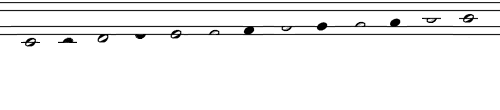
Chromatic Twinline by Leo de Vries (1986)
Diatonic Twinline by Leo de Vries (1986)
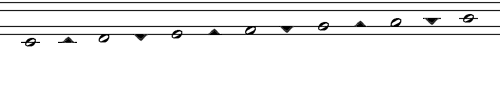
Twinline by Thomas Reed (1986)
Black-Triangle Twinline by Doug Keislar (2006)
White-Triangle Twinline by Paul Morris (2006)
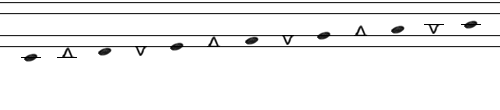
Bilinear Notation by Jose Sotorrio (1997)
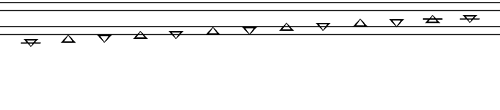
TwinNote by Paul Morris (2009)
TwinNote (Max 6-6 Version) by Paul Morris (2009)
Chromatic Twinline and Diatonic Twinline by Leo de Vries


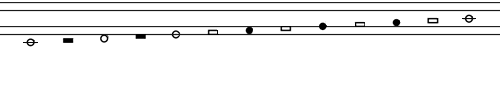
A 2-line staff is used, with the lower line representing E. Above and below the staff a ledger line is used to represent C. Between any two adjacent lines there are three elevations on which notes can be placed. These elevations are made easier to distinguish because the notehead is given a semicircular shape when it rests against a line. Rhythmic notation is mostly traditional.
In Chromatic Twinline, the top image, the notehead color alternates in a 6-6 pattern, with the semicircles black and the ovals white.
In Diatonic Twinline, the bottom image, the notehead color corresponds to the 7-5 pattern of the piano key color. De Vries intended this version to be a temporary, transitional notation for those moving from traditional notation to Chromatic Twinline.
Earliest documentation: 1986
Source: Directory of Music Notation Proposals, section/page: 10/11, 11/2, 13/25
Manuscript paper: Discontinuous Staves Continuous Staves
Twinline Notation by Thomas Reed

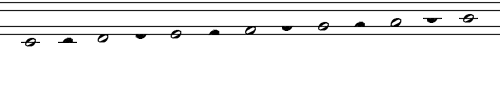
A two-line staff is used, with the lower line representing E. Above and below the staff a ledger line is used to represent C. Between any two adjacent lines there are three elevations on which notes can be placed. These three elevations are made easier to read because of a change in notehead shape. As illustrated, the notes next to a line assume a triangular shape, with the base of the triangle resting on the closer line. The notes are all white for ease of handwriting. Rhythmic notation is mostly traditional. A novel flag indicates half notes. Tom Reed's Twinline is his modification of Leo de Vries' Twinline systems (above).
Earliest documentation: 1986
Source: Directory of Music Notation Proposals, section/page: 10/24, 11/2, 13/72
Miscellaneous examples: Major Scale Comparison Triad Comparison Jazz Chords Comparison
Manuscript paper: Discontinuous Staves Continuous Staves
Black-Triangle Twinline by Doug Keislar

This is Keislar's suggested variant of Tom Reed's Twinline (which is itself a version of de Vries' Twinline). Here the triangle shaped noteheads are filled solid, much like de Vries' Chromatic Twinline (above). This emphasizes the 6-6 pitch pattern via notehead color in addition to notehead shape, and makes it easier to distinguish the triangles from the ovals. In handwritten as opposed to printed music, the triangles can optionally be left hollow to make them easier to write quickly. In this case the notation is the same as Reed's Twinline. An even faster option for handwritten music is to write the ovals as dots, the upward-pointing triangles as forward slashes (/), and the downward-pointing triangles as backward slashes (\).
When compared to White-Triangle Twinline (below), the differentiation between hollow ovals (those with lines through them, versus those without) is arguably an advantage, because it aids visual discrimination between the ovals.
Source: Doug Keislar, 2006
Miscellaneous examples: Jazz Chords Comparison (called "Black and White Twinline" in this file)
Manuscript paper: Discontinuous Staves Continuous Staves
White-Triangle Twinline by Paul Morris

This is Morris' version of Reed's Twinline. It uses hollow triangle notes and solid oval notes. As with DeVries' Chromatic and Keislar's Black-Triangle variants, this emphasizes the 6-6 pitch pattern and makes it easier to distinguish the two types of notes. When writing by hand the ovals can optionally be left hollow, making them easier to write. It has an optional companion notation: Expanded White-Triangle Twinline.
Compared to Black-Triangle Twinline above, it has a slightly stronger 6-6 pitch pattern since the solid ovals have a more consistent appearance (rather than hollow ovals that sometimes have a line visible through them). This also provides a less "busy" appearance overall, and opens up more possibilities for using alterations to the notehead as an alternative accidental system. (Small dots inside the notehead, for example.)
Having solid ovals also gives quarter notes, eighth notes, sixteenth notes, etc... a more consistent appearance when switching back and forth from traditional notation. Any note with a stem and a solid oval notehead will mean the same thing in both systems. Since these notes are generally more numerous than half notes or whole notes, this is arguably another advantage over Black-Triangle Twinline. A double stem is used to indicate half notes and to mark their difference from quarter notes. See Using Notehead Color for Pitch. Otherwise traditional rhythmic notation is used.
Source: Paul Morris, 2006. (The notehead color makes this system quite similar to Sotorrio's Bilinear Notation (below). Bilinear pre-dates this system, which was however designed without prior knowledge of Bilinear. Some differences include the rhythmic notation of whole notes and half notes, and the precise shape of the triangular noteheads.) (This system was briefly named "TwinNote" between June and December of 2009, before Morris introduced his newer version of TwinNote -- see below.)
Similar Notations: Expanded White-Triangle Twinline by Paul Morris
Manuscript paper: Discontinuous Staves Continuous Staves
Webpage: on the Music Notation Project Wiki
Bilinear Notation by José A. Sotorrío

Bilinear is quite similar to Reed's Twinline (above). Sotorrio maintains he had no prior knowledge of Twinline when designing Bilinear, since he relied primarily on Gardner Read's Source Book of Proposed Music Notation Reforms which does not include Twinline. (It was published in 1987, just after Twinline was introduced in 1986.) Since Twinline is the earlier system (Bilinear was introduced in 1997), Sotorrio now offers Bilinear as a variant of Twinline.
The two systems share the same line pattern and the same alternating oval and triangle shaped noteheads, but there are differences in their details. Twinline's triangles are right triangles with the 90 degree angle at their tip, while Bilinear's triangles have a sharper angle at their tip. Also, the shape, color, and size of noteheads in Bilinear may be different depending on a note's duration, as illustrated in the following image (courtesy of the Bilinear website):

For notes a quarter note or shorter in duration, solid ovals and hollow triangles are used. For half note or whole note durations, larger hollow ovals are used instead of solid ovals (as in traditional notation), and hollow half-ovals are used instead of triangles. Ease of handwriting was a consideration in designing this system of rhythmic notation.
Bilinear offers new register symbols and an optional system for using color to indicate sharps, flats and naturals. It introduces optional stand-alone symbols for notes, for use in writing apart from a staff, but derived from their appearance on a staff. It also attempts to standardize accidentals for microtones and chord symbols, and adds new ‘interval units’. More information on these details is available from the Bilinear website.
Earliest documentation: 1997
Website: www.SpectralMusic.com
Source: www.SpectralMusic.com and José A. Sotorrío
TwinNote (standard and Max 6-6 versions) by Paul Morris

TwinNote has the same basic line-pattern and compact staff as Twinline (above), but it uses only triangle noteheads that appear in one of two orientations. Two notes appear on each line and space, one oriented 'point-up' and the other oriented 'point-down'. These two types of notes emphasize the 6-6 pitch pattern. In the standard version of TwinNote rhythm notation is identical to traditional music notation, making it easier to learn both systems and use them interchangeably. Also the use of only triangle noteheads would likely reduce any confusion since the two systems are more visually distinct.

In the "Max 6-6" version of TwinNote (shown just above) the upward pointing triangles are always solid, and the downward pointing triangles are always hollow, regardless of their duration (see Using Notehead Color for Pitch). This maximizes the visibility of the 6-6 pitch pattern. Half notes are given a double stem to differentiate them from quarter notes. Otherwise traditional rhythmic notation is used.
Various forms of short-hand can be used when writing music by hand. For example, all triangles can be left hollow, and the base of the triangles can be omitted, reducing the number of strokes required for each notehead to just two.
Source: Paul Morris, December 2009. (White-Triangle Twinline (above) was briefly known as "TwinNote" from June to December 2009, before Morris designed this system which took over the name TwinNote.)
Website: TwinNote Music Notation
Manuscript paper: Discontinuous Staves Continuous Staves