Lines a Major 3rd Apart,  2 Lines per Octave

From the Guided Tour: These systems are similar to those with three lines, a major third apart, only they have a ledger line instead of a bold or dashed line for their third line per octave. This gives them an even less dense appearance and allows for easy identification of the lines when staves are stacked contiguously for greater pitch range. Lines spaced a major third apart have three note elevations in the spaces between the lines. Some systems use notehead color to help differentiate between adjacent pitches.


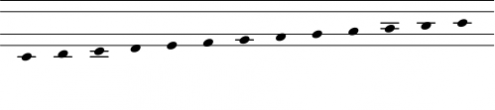
Panot Notation by George Skapski

The two lines of the staff represent E and G#/Ab.  Above and below the staff a leger line is used to represent C.  Between any two adjacent lines, including the leger line, there are three elevations on which notes can be placed.  The standard staff spans two octaves as pictured above. All the notes are black and circular.   A novel rhythmic notation is used.

Earliest documentation: 1956 (Skapski, G. "Some Aspects of Music Notation and a Proposed New System," Masters Thesis, University of Tulsa)

Source: Directory of Music Notation Proposals section/page: 10/29, 11/2, 13/89

Manuscript Paper: Discontinuous Staves  Continuous Staves

(Note that this manuscript paper has been revised since the MNMA's Research Project, so that it is now more in-line with the inventor's intentions.)


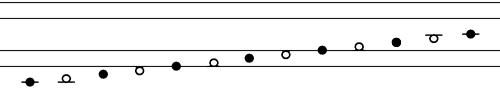
Untitled by Johannes Beyreuther

The staff has two lines representing E and G#/Ab. Above and below the staff a ledger line represents C.  The standard staff spans two octaves as pictured above. Circular noteheads alternate between solid/black and hollow/white, highlighting the 6-6 pitch pattern. Rhythmic notation is proportional somewhat like Klavar notation. Beyreuther later withdrew this proposal in favor of its "dashed line" cousin.

Earliest documentation: 1959 (Canadian patent No. 568746, titled "Musical Staff")

Source: Directory of Music Notation Proposals, section/page: 10/4, 11/2, 13/9

Similar Notations: Chromatic 6-6 Notation by Johannes Beyreuther

Miscellaneous examples: Major Scale Comparison  Triad Comparison  

Manuscript Paper: Discontinuous Staves  Continuous Staves


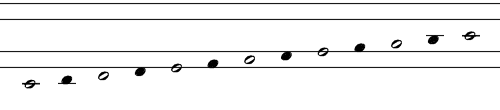
Expanded White-Triangle Twinline by Paul Morris

This is Morris' version of Beyreuther's Untitled (above), with a few differences. Rhythmic notation is not proportional, but follows traditional notation, except for a double stem that indicates half notes (see Using Notehead Color for Pitch). Noteheads are the traditional oval shape rather than circular. As with Beyreuther's Untitled, noteheads alternate between solid and hollow, highlighting the 6-6 pitch pattern. Ledger lines may optionally be shown for the notes D and A#/Bb to help make their position clear, as shown in the illustration above.

As its name indicates, this notation is intended as a companion to White-Triangle (W.T.) Twinline. They share the same line pattern and notehead color pattern. Their compatibility makes it easy to read either system interchangeably, since knowledge of one system readily transfers to the other. The only differences are W.T. Twinline's vertical compression of the staff and use of triangular noteheads. Expanded W.T. Twinline could be used as a transitional notation to introduce beginners to W.T. Twinline, helping them understand the interval relationships between the notes. It might even be preferred as a primary notation for musicians who play instruments with a smaller pitch range and do not benefit as much from a vertically compressed staff.

Earliest documentation: 2006

Source: Paul Morris. (This system was briefly known as "Expanded TwinNote" between June and December of 2009, before the introduction of Morris' new version of TwinNote.)

Similar Notations: White-Triangle Twinline by Paul Morris, Chromatic 6-6 Notation by Johannes Beyreuther

Manuscript Paper: Discontinuous Staves  Continuous Staves


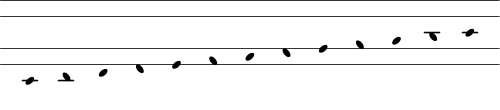
Chromatic Lyre Notation by Jan Braunstein

Braunstein's notation system was directly inspired by Johannes Beyreuther's systems. It is suitable for use as a general purpose notation, but he designed it with Chromatic Lyres in mind. Chromatic lyres are isomorphic instruments with two rows of strings tuned in a 6-6 pitch pattern of two interlocking whole tone scales. One row of strings is played by the right hand and the other by the left hand.

The notation system has the same line pattern as those shown above (lines for E and G#/Ab, and a ledger line for C). Like Beyreuther's systems it also uses hollow and solid notes to emphasize the 6-6 pitch pattern. On a chromatic lyre the solid and hollow notes each correspond to a row of strings and the hand that plays them. Braunstein made the line-notes hollow in order to aid with handwriting. This allows solid notes to be written quickly as small dots, avoiding the risk that they might visually blend into a line (if they had been used for line-notes). It also helps differentiate hollow notes on lines from those in spaces since you can see the line through them.

Braunstein's system uses a traditional alto clef to indicate the position of middle C. It incorporates 8va, 8vb, 15va, or 15vb symbols into the clef to indicate the staff has a higher or lower pitch range. Rhythmic notation is the same as traditional notation with the following exceptions. Half notes (minims) have no stem to distinguish them from quarter notes (crotchets). Whole notes (semibreves) have a single vertical line on either side of the notehead. Double whole notes (breves) have a double vertical line on either side of the notehead. Rests also follow this same symbolic convention. These are illustrated on the notation's website.

Earliest documentation: 2009

Website: http://www.delos.cz/en/Chromatic_Notation.html

Source: Jan Braunstein

Similar Notations: Chromatic 6-6 Notation by Johannes Beyreuther

Manuscript paper is available at the Chromatic Lyre Notation website


Exploring alternative
music notation systems.